Almost everyone planning their first African safari runs into the same decision paralysis: Kenya, Tanzania and South Africa all market themselves as premier safari destinations, all deliver genuinely extraordinary wildlife, and all cost meaningfully different amounts of money for meaningfully different kinds of trip. None of them is objectively "the best," they are built for different priorities, and figuring out which priorities matter to you is most of the decision.
Kenya: the classic, crowd-friendly choice
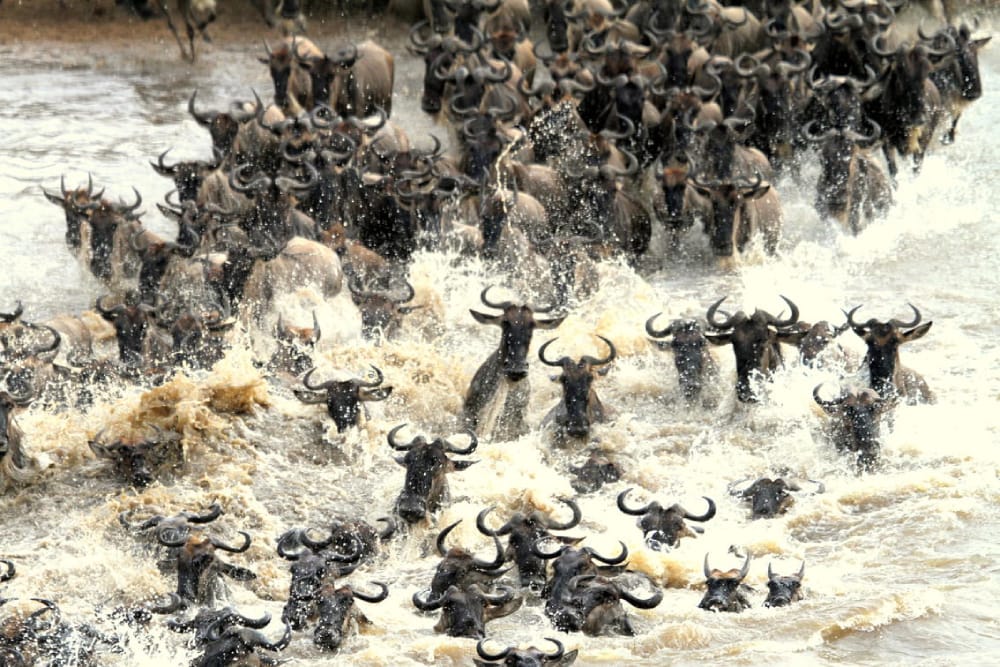
Kenya's Maasai Mara is probably the single most famous safari landscape in the world, rolling savanna that hosts the annual wildebeest migration's dramatic river crossings roughly from July to October. Kenya's parks are generally more accessible than Tanzania's equivalent sites, shorter transfer times from Nairobi, a well-developed network of camps and lodges across every budget level, and a tourism industry with decades of experience managing international visitors. The trade-off is crowds: the Mara during peak migration season can mean a dozen or more vehicles at a single sighting, a genuine drawback for travellers who picture safari as solitary wilderness. Amboseli, with its Kilimanjaro backdrop and dense elephant population, and Lake Nakuru's rhino sanctuary round out a typical Kenya itinerary well outside the single-park Mara focus.
Tanzania: bigger, wilder, more expensive
Tanzania holds the other half of the same migration ecosystem, the Serengeti, along with the Ngorongoro Crater, a collapsed volcanic caldera so densely packed with wildlife that it functions almost like a natural wildlife enclosure, and the more remote southern circuit parks, Ruaha and the Selous (now Nyerere), which see a fraction of the Serengeti's visitor numbers for travellers who genuinely want to feel alone with the wildlife. Tanzania's parks tend to be larger and less developed than Kenya's, which means longer drives between sightings but a stronger sense of untouched wilderness, and its conservation fee structure and generally higher-end lodge market make it noticeably more expensive than Kenya for an equivalent-length trip. Tanzania rewards travellers with more time and budget who want the same migration spectacle with fewer vehicles at each sighting, plus the crater and southern circuit as genuine alternatives to the crowded northern parks.
South Africa: the easiest entry point
South Africa's Kruger National Park and the private reserves bordering it, Sabi Sands especially, offer something the East African parks generally do not: excellent tarred and gravel road infrastructure, self-drive safari options for budget travellers, malaria-free reserves in some regions (Madikwe, parts of Eastern Cape) for families travelling with young children, and direct pairing with Cape Town, wine country and the Garden Route for a trip that combines safari with a very different, more developed kind of travel. South Africa's private reserves, where guides can drive off-road for close sightings rather than staying on marked tracks as in most public parks, often deliver more intimate wildlife encounters than Kenya or Tanzania's public parks, at a price point that runs from genuinely mid-range self-drive Kruger to extremely high-end private reserve lodges.
The migration question
If witnessing the wildebeest migration is the priority, the decision comes down to timing and specific location rather than country: the migration is a year-round circular movement through the Serengeti-Mara ecosystem, roughly in the southern Serengeti (Tanzania) calving season from January to March, moving north through the western corridor from April to June, and reaching the Mara river crossings, the most dramatic and widely photographed part, from July to October before heading back south. Both countries can deliver a genuine migration experience depending on when you go; neither has an exclusive claim on it.
What each country actually costs
Kenya generally offers the widest range, from budget group-tour camping safaris around USD 150-250 per person per day to luxury tented camps well over USD 800. Tanzania runs higher on average, largely due to higher park and conservation fees, with a realistic mid-range trip starting around USD 300-400 per day and premium options extending well beyond USD 1,000. South Africa offers the most accessible budget option of the three through self-drive Kruger, camping and rest camp accommodation can bring a day's cost under USD 100, while private reserve lodges compete with or exceed Tanzania's high end.
Malaria and health considerations
Most of Kenya and Tanzania's classic safari circuits are malaria zones, requiring prophylaxis for most travellers, a genuine consideration for families with young children or anyone with health conditions that complicate antimalarial use. South Africa offers malaria-free options, several reserves in the Eastern Cape and Madikwe near the Botswana border operate in malaria-free zones while still delivering Big Five sightings, a meaningful advantage for family safari trips specifically.
Combining countries
None of this requires an exclusive choice. A reasonably common itinerary pairs the Serengeti and Ngorongoro Crater with a few days on Zanzibar's beaches for post-safari relaxation, both in Tanzania and requiring no additional border crossing logistics. Kenya and Tanzania can be combined via the Mara-Serengeti border, though this typically means backtracking through Nairobi or Arusha rather than a direct crossing. South Africa, being geographically distant from the East African parks, is best treated as its own separate trip rather than combined in a single itinerary unless you have three or more weeks available.
Making the actual decision
For a first safari with a genuinely flexible budget and a priority on seeing the migration at its most dramatic, Kenya's Maasai Mara during the July-October crossing season remains the benchmark experience. For travellers with more time, higher budget, and a preference for a wilder, less crowded feel, Tanzania's combination of the Serengeti and Ngorongoro Crater, or the southern circuit parks for real solitude, wins out. For families with young children, self-drivers on a budget, or anyone wanting to pair safari with a broader trip covering wine country and coastline, South Africa is the most practical entry point into African safari travel. All three deliver genuine, unforgettable wildlife encounters; the choice is really about which trade-offs, cost, crowds, malaria exposure, logistics, matter most to you.
Visas and getting there
Kenya and Tanzania both use an online eVisa system for most nationalities, straightforward to arrange in advance but worth doing at least a couple of weeks ahead of travel rather than assuming a same-day approval. South Africa allows visa-free entry for a long list of nationalities, including the US, UK, EU and Australia, for stays under 90 days, one less piece of admin on top of an already logistics-heavy trip. Flight-wise, Nairobi and Johannesburg both function as major international hubs with frequent long-haul connections, while Kilimanjaro International Airport, serving Tanzania's northern circuit, has a thinner network and often means routing through Nairobi, Addis Ababa or Amsterdam. None of these differences are dealbreakers on their own, but stacked together they do shift the amount of pre-trip planning each country demands.